Synastry Oppositions Checklist: Bridge the Push-Pull
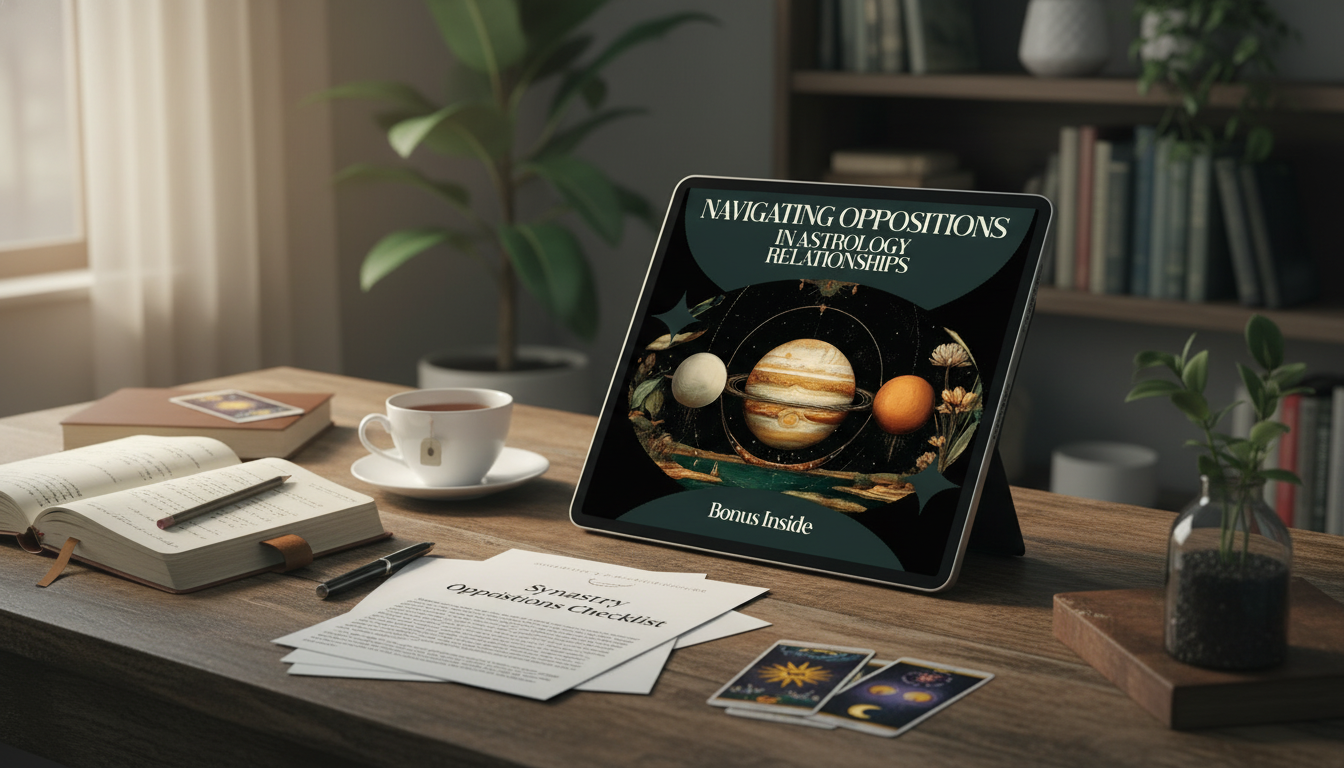
Navigating Oppositions in Relationship Astrology: A Practical Checklist for Synastry
Oppositions in synastry can feel like instant magnetism paired with recurring friction: two people pulling toward different needs, styles, or tempos. When handled consciously, an opposition often becomes a growth engine—highlighting what each partner overuses, avoids, or projects onto the other. The goal is not to “fix” the other person, but to build a workable bridge between two ends of the same axis through awareness, communication, and repeatable practices. For more guidance, see [PDF] The Evolving – OPA Astrology.
For quick definitions and broader context on aspects and synastry, these references are helpful: Astro-Databank Encyclopedia: Aspects, Cafe Astrology: Aspects in Astrology, and Astrology.com: Synastry.
What an Opposition Means in Relationship Astrology
An opposition is a 180° aspect connecting two points across a zodiac axis; it emphasizes polarity, visibility, and mirror-like dynamics. In synastry, oppositions can indicate strong chemistry, fascination, and a sense that the other person “completes” what feels missing—alongside push-pull patterns.
Oppositions are often easier to notice than softer aspects because they create contrast: different preferences, priorities, emotional rhythms, or conflict styles. When balanced, oppositions become complementary: each partner learns to integrate the other side of the axis rather than rejecting it.
Opposition Quick-Read: From Tug-of-War to Teamwork
| Synastry Opposition | Common Tug-of-War | Balancing Action | Reflection Prompt |
|---|---|---|---|
| Sun ⟂ Moon | Identity vs emotional needs | Name needs + set predictable rituals | Where does validation matter most to each person? |
| Venus ⟂ Mars | Affection vs desire; pace mismatches | Agree on initiation cues and boundaries | What makes each person feel wanted and safe? |
| Mercury ⟂ Mercury | Different thinking/communication styles | Summarize before responding; define terms | What topic triggers defensiveness fastest? |
| Moon ⟂ Saturn | Sensitivity vs caution; fear of burden | Use gentle structure; reassure with consistency | What does commitment look like day to day? |
| Mars ⟂ Saturn | Drive vs delay; frustration with limits | Plan timelines; channel energy into shared goals | Where does “no” protect the relationship? |
Why Oppositions Feel Personal (Even When They’re Not)
Oppositions can trigger projection: qualities that feel uncomfortable internally may be experienced as “the other person’s problem.” Because the planets sit across an axis, the dynamic creates a recurring choice point—default to one end (habit) or integrate both (maturity).
Stress increases polarization; under pressure, partners often cling tighter to their own end of the axis. Healthy integration includes both/and thinking: needs can be different without being incompatible. The relationship improves when differences are treated like signals to negotiate, not evidence that someone is “wrong.”
Your Checklist for Working With Synastry Oppositions
1) Get specific about the aspect
Identify the exact planets/points and signs involved; then note houses for the life areas where the push-pull plays out (money, intimacy, home, social life, work, etc.). A Venus–Mars opposition across the 2nd/8th houses will behave differently than the same opposition across the 5th/11th.
2) Name the repeating cycle (without blaming)
Spot the pattern: what happens before the conflict, during it, and after it. Put the cycle into neutral language: “When we’re rushed, we polarize—one pushes for action, the other pulls back to get certainty.” This keeps the problem observable and workable.
3) Translate each end of the axis into a need
Each end usually represents a legitimate need expressed differently. One side may seek immediacy or expression; the other may seek safety, space, structure, or time (the exact flavor depends on the planets involved). The goal is to hear the need underneath the behavior.
4) Choose one “bridge behavior” you can repeat
Bridge behaviors are simple, consistent actions that reduce the swing between extremes: timeouts with a return time, scheduled check-ins, a decision rule (“sleep on big purchases”), or clear initiation signals around affection and intimacy.
5) Run a two-week experiment, then review
Set one measurable experiment for 2 weeks (not a permanent vow). Try a new habit, then review: What improved? What got worse? What needs adjusting? Oppositions respond best to iteration.
6) Track triggers and repairs
Keep notes on what escalates quickly, and what reliably brings you back to connection (apology style, reassurance, touch, humor, or a practical reset like food/sleep). Repairs matter as much as triggers—often more.
Common Relationship Themes by Planet Pair
Oppositions have different “textures” depending on which planets are involved:
- Luminaries (Sun/Moon): Core identity and emotional nourishment; often shows up as feeling unseen vs feeling smothered, or “I need recognition” vs “I need comfort.”
- Personal planets (Mercury/Venus/Mars): Communication tone, affection style, conflict and initiative; frequent daily-life friction with strong attraction.
- Social planets (Jupiter/Saturn): Optimism vs realism; growth vs responsibility; tension between freedom and duty (or risk and restraint).
- Outer planets (Uranus/Neptune/Pluto) to personal planets: Intensity, change, idealization, or power dynamics; requires extra care with consent, boundaries, and grounding.
- Angles (ASC/DSC/IC/MC) and nodes: Can feel fated or highly formative; watch for repeating life lessons and identity shifts.
Turning Conflict Into Collaboration
Using a Worksheet to Reflect Without Spiraling
Digital Guide for Practicing the Checklist
If it helps to have the process laid out in a ready-to-use format, Your Checklist for Navigating Oppositions in Astrology Relationships (Digital Guide + Worksheet) organizes the exact opposition, triggers, and practical bridge behaviors in one place. It works well for personal reflection, couples check-ins, or preparing for a calmer conversation.
For couples who notice oppositions flaring under stress while planning trips, sharing logistics, or navigating unfamiliar environments, the Travel Security & Scam Awareness Guide | Digital Safety Handbook for Tourists, Solo Travelers & Business Trips can support smoother coordination by reducing external pressure—often the very thing that intensifies polarization.
FAQ
What is your checklist meaning?
A checklist is a step-by-step set of prompts and actions that helps you identify the specific opposition, name the needs on both sides, choose repeatable “bridge behaviors,” and review results after testing a small change. It’s practical and process-based rather than predictive.









Leave a comment