Printable Cat Body Language Cheat Sheet: Tails, Ears, Meows
Cat Body Language & Behavior Cheat Sheet: A Printable Guide to Signals, Postures, and Meows
Cats communicate constantly—just not always in ways humans recognize. Learning to read tail positions, ear angles, eye cues, and vocal patterns can reduce stress, prevent scratches and bites, and build real trust. A printable “cheat sheet” format makes it easier to decode common feline signals quickly during play, petting, introductions, or routine care—especially when multiple cues happen at once.
How to read cat communication (fast and accurately)
Cat body language works like a full-body sentence, not a single word. A tail flick can mean “I’m focused” in one moment and “I’m done” in another—depending on the rest of the body and what’s happening around the cat.
- Look at the whole cat: eyes + ears + tail + posture + movement + context (food time, strangers, loud sounds, other pets).
- Check the direction of intent: approaching, freezing, retreating, hiding, stalking, or swatting changes what the same signal means.
- Prioritize safety signals: stiff body, pinned ears, hard stare, growling/hissing, and a thrashing tail usually mean “give space now.”
- Use distance and choice: let the cat come forward; offer an exit route and avoid cornering.
For deeper behavior basics and stress-reduction tips, reputable references include International Cat Care (iCatCare), the ASPCA cat behavior resources, and AAFP Cat Friendly guidance.
Tail language: what the tail is really saying
The tail is one of the fastest “volume knobs” on a cat’s emotional state. Watch speed, height, and tension—then confirm with ears and body posture before acting.
- Upright tail (often with a soft curve): friendly, confident greeting; usually safe to engage if the rest of the body matches.
- Low tail or tucked tail: uncertainty, fear, or discomfort; reduce stimulation and increase distance.
- Puffed tail: high arousal (fear or excitement); avoid picking up and allow a calm-down path.
- Thrashing or whipping tail: irritation or conflict; stop petting/playing and reset.
- Slow, gentle tail-tip movement: focused interest; often seen during watching, stalking, or curious investigation.
| Tail cue | Common meaning | Helpful response |
|---|---|---|
| Upright tail (soft) | Friendly, social | Offer a hand to sniff; keep interaction gentle |
| Tucked/low tail | Fear or uncertainty | Lower noise, give space, move slowly |
| Puffed tail | High arousal | Pause interaction; let the cat retreat |
| Fast thrash | Overstimulated/annoyed | Stop petting; end play; allow calm time |
| Tail-tip flick | Interest or impatience | Redirect to a toy; avoid pushing contact |
Ears and eyes: the clearest “yes/no” signals
When you’re unsure how a cat feels, ears and eyes usually give the most reliable “green light/yellow light/red light” clues.
- Ears forward: engaged and curious; often receptive if the body stays loose.
- Ears sideways (“airplane ears”): conflicted or uneasy; reduce pressure and let the cat control distance.
- Ears pinned back: defensive or escalating; don’t pet, pick up, or loom.
- Soft, slow blinking: relaxed and affiliative; a slow blink back can help de-escalate.
- Dilated pupils: arousal (fear, excitement, pain, or play); interpret with posture and situation.
- Hard stare: warning or challenge; break eye contact and create space.
Postures and movement: relaxed, playful, stressed, or defensive
Posture shows whether a cat feels safe enough to be social—or whether they’re preparing to flee or defend themselves.
- Loose body, weight evenly distributed: relaxed; typical in a secure environment.
- Crouched low with tension: uncertain or fearful; avoid reaching overhead and offer hiding options.
- Side-lying belly exposure: sometimes relaxed, but not always an invitation to touch; watch paws and tail for tension.
- Arched back with sideways stance: defensive display; increase distance and remove triggers if possible.
- Freezing: deciding between flight and fight; stop advancing and allow a clear retreat route.
- Play signals (bouncy movements, chase invitations): keep hands away; use wand toys to prevent bites.
Meows and other sounds: what vocalizations often mean
Cats often “aim” meows at humans. Instead of searching for one perfect translation, listen for patterns and match them to context and body language.
- Short meow: greeting or quick request; often paired with upright tail and forward ears.
- Repeated meows: attention-seeking, food routines, or “help me with this” (like a closed door); check schedule changes and environment.
- Yowl/howl: distress, territorial signaling, or pain; if sudden or persistent, a veterinary check is a smart next step.
- Purring: can mean contentment, but also self-soothing when stressed or unwell; confirm with posture.
- Hiss/growl/spit: “back off”; don’t punish—create distance and reduce the trigger.
- Chirp/chatter: excitement (often at birds/prey); typically normal unless paired with fear cues.
Common mixed messages (and how to respond)
Fridge-ready cheat sheet: where a printable guide helps most
Printable Cat Communication Guide: what’s included and how to use it
Recommended digital guides (in stock)
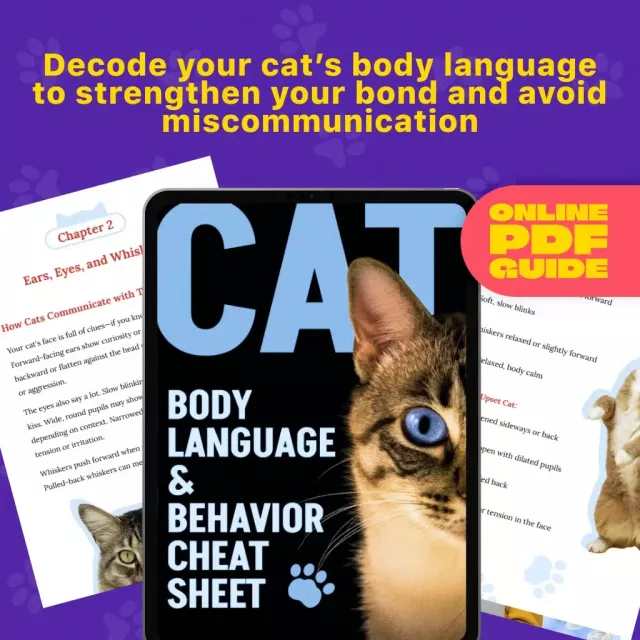
- Cat Body Language & Behavior Cheat Sheet (Printable Cat Communication Guide)
- Travel Security & Scam Awareness Guide | Digital Safety Handbook for Tourists, Solo Travelers & Business Trips
- Top 50 Side Hustles That Actually Pay | Digital Download PDF eBook
FAQ
Why does a cat swish its tail while being petted?
Tail swishing during petting often signals rising overstimulation or irritation, especially when it becomes a fast thrash. A slow tail-tip flick can also mean focused interest, so compare it with ears, skin twitching, and body tension; when in doubt, stop petting, give space, and redirect to a toy.
Does purring always mean a cat is happy?
No—purring can mean contentment, but it can also be self-soothing when a cat is stressed, scared, or in pain. If purring is paired with hiding, tense posture, reduced appetite, or a sudden behavior change, a veterinary check is a good idea.
What are the clearest signs a cat wants to be left alone?
Pinned ears, a hard stare, a tense crouch, growling/hissing, tail thrashing, freezing, hiding, and swatting are strong “no contact” signals. Back up, avoid cornering, and give an easy escape route so the cat can decompress.










Leave a comment